

INTRODUCTION
Cabbage doesn’t get much of a fan club. It sits in the crisper drawer behind lettuce and spinach, mostly ignored until St. Patrick’s Day rolls around and someone remembers corned beef exists. That’s a shame, because when you treat cabbage right, it does something wonderful — it goes soft and almost sweet, soaking up whatever sauce it’s swimming in like a sponge that somehow still holds its shape.
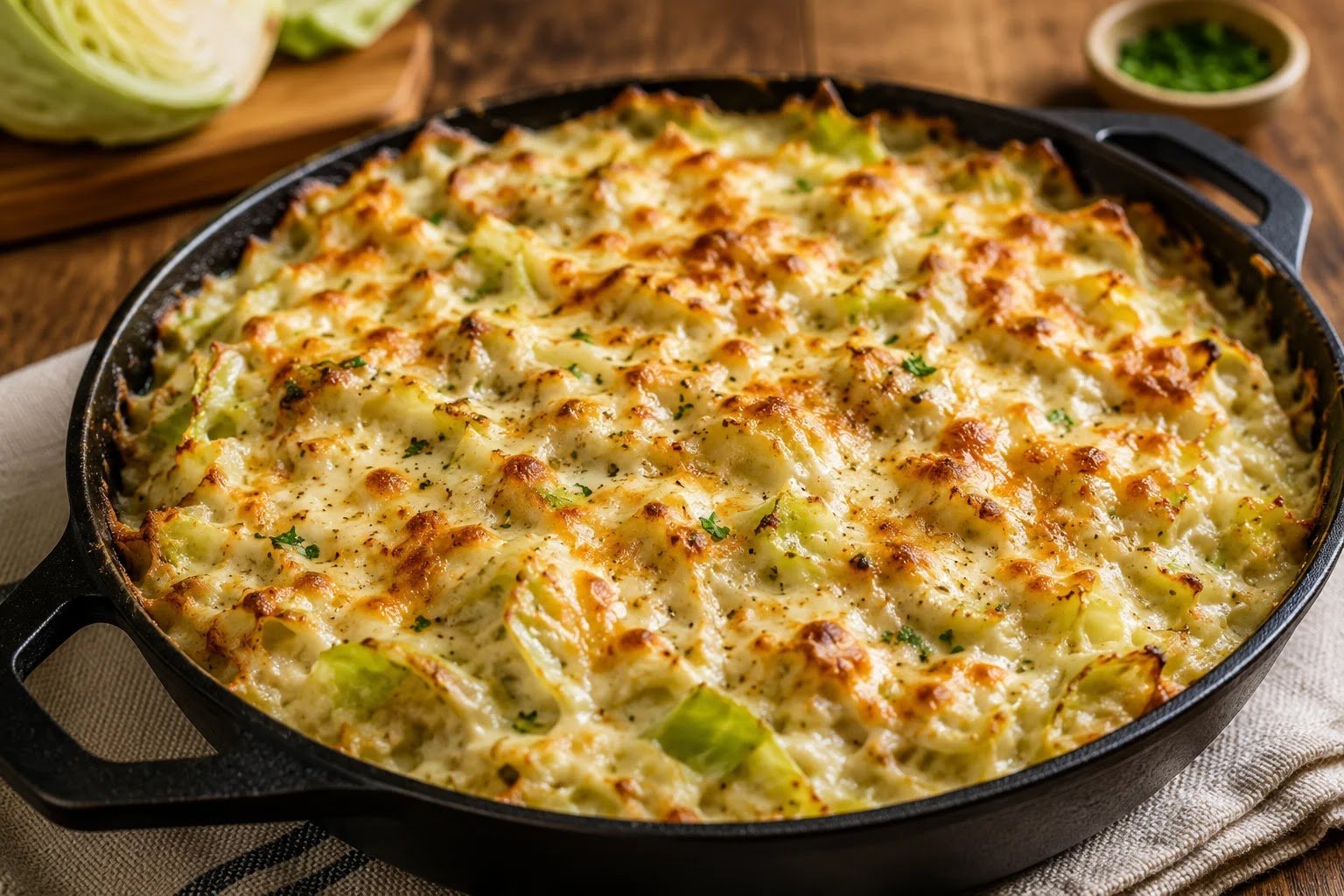
That’s exactly what happens here. This Cabbage Alfredo Bake takes wedges of cabbage, blankets them in a homemade garlic-parmesan alfredo sauce, and bakes the whole thing until the top turns golden and blistered and the cabbage underneath goes tender enough to cut with a fork. It tastes like the lovechild of a cheesy gratin and a classic Alfredo pasta night — minus the pasta, minus the guilt, plus a genuinely surprising amount of flavor from a vegetable most people underestimate.
If you’re looking for a low-carb dinner that doesn’t taste like a compromise, a comfort food side that could just as easily be the main event, or a way to use up a head of cabbage before it turns on you — this is the recipe. It’s a one-dish, hands-off bake that goes from stovetop to oven to table in under an hour, and it holds up beautifully as leftovers, which is more than I can say for most cream-sauce dishes.
If cabbage done right has become your new favorite kitchen trick, don’t stop here. My Golumpki Souptakes the same humble vegetable in a completely different direction — cabbage, ground beef, rice, and tomato broth simmered into a cozy one-pot soup that channels all the flavor of stuffed cabbage rolls without any of the rolling. Between the two, you’ve got cabbage covered for both creamy bake nights and brothy soup nights.
QUICK RECIPE FACTS
| Prep Time | 15 minutes |
| Cook Time | 40 minutes |
| Total Time | 55 minutes |
| Servings | 6 |
| Cuisine | American comfort food |
| Course | Main dish or side dish |
| Difficulty | Easy |
| Calories | ~310 per serving |
| Protein | 12g |
| Carbs | 11g |
| Fat | 25g |
TABLE OF CONTENTS
- Why You’ll Love This Recipe
- Ingredient Guide
- Equipment Guide
- Step-by-Step Instructions
- Expert Tips
- Common Mistakes
- Recipe Variations
- Serving Ideas
- Storage
- Troubleshooting
- Kitchen Essentials We Actually Use
- Frequently Asked Questions
- Recipe Card
WHY YOU’LL LOVE THIS RECIPE
This bake is for the person who loves a creamy casserole but doesn’t want to build a whole pasta bake from scratch, and it’s for the low-carb crowd looking for something that actually feels like a treat instead of a substitution. It’s for busy weeknights, because the sauce comes together in the same pot you wilt the cabbage in — one pan, one bake dish, minimal cleanup.
Flavor-wise, the cabbage turns almost buttery once it’s baked in the sauce, and the parmesan crisps up on top into little golden edges that everyone fights over. Texturally, you get soft cabbage, silky sauce, and a crisp top all in one bite. Nutritionally, it leans into vegetables instead of starch, so it fits comfortably into keto, low-carb, and gluten-free eating patterns without tasting like it. And because it reheats so well, it’s a genuinely solid meal-prep candidate — portion it into containers and you’ve got lunch sorted for half the week.
If creamy, cheesy bakes are already your thing, you’ll probably also love my Roasted Cheese Zucchini — it’s built on the same idea of letting a humble vegetable soak up a rich, melty sauce until it barely resembles a “side dish” anymore.
INGREDIENT GUIDE

Cabbage (1 large head, green) — The star. Look for a head that feels heavy for its size with tight, crisp leaves. Green cabbage holds its structure best through baking; savoy works too but breaks down faster. Store whole cabbage in the crisper drawer for up to two weeks.
Butter (4 tablespoons) — Builds the roux base for the alfredo sauce. Unsalted gives you control over final seasoning.
Garlic (4 cloves, minced) — Fresh garlic makes a real difference here; jarred minced garlic works in a pinch but has a flatter flavor.
All-purpose flour (3 tablespoons) — Thickens the sauce. For gluten-free, swap in a 1:1 gluten-free flour blend or cornstarch (use half the amount).
Heavy cream (2 cups) — The backbone of the alfredo. Half-and-half can work for a lighter sauce, though it won’t be quite as rich or thick.
Chicken or vegetable broth (1 cup) — Loosens the sauce and adds depth. Low-sodium is best so you can control salt yourself.
Parmesan cheese (1½ cups, freshly grated) — Pre-shredded parmesan contains anti-caking agents that keep it from melting smoothly, so grate your own block if you can.
Mozzarella cheese (1 cup, shredded) — Adds the stretchy, melty quality on top.
Nutmeg (¼ teaspoon) — A classic, subtle addition to cream sauces that rounds out the flavor without tasting overtly like nutmeg.
Salt and black pepper — Season in layers: a little when wilting the cabbage, more when the sauce is built.
Red pepper flakes (optional, a pinch) — For a background warmth that plays well against the richness.
EQUIPMENT GUIDE
Large oven-safe skillet or Dutch oven — Lets you wilt the cabbage, build the sauce, and transfer straight to the oven without dirtying a second dish. A cast iron skillet is the budget-friendly workhorse here; an enameled Dutch oven is the upgrade if you already bake casseroles often.

9×13 baking dish — If your skillet isn’t oven-safe, this is the fallback. Ceramic retains heat evenly and browns the top nicely.
Box grater or food processor with grating attachment — For freshly grating parmesan and mozzarella, which melt far better than pre-shredded bags.
Whisk — Essential for a lump-free sauce; a flat roux whisk works especially well in a wide pan.
Sharp chef’s knife — For cutting the cabbage into even wedges so everything cooks at the same rate.
STEP-BY-STEP INSTRUCTIONS
Step 1 — Cut the cabbage into wedges.
Remove any tough outer leaves, then cut the head into 6–8 wedges through the core, keeping the core intact so each wedge holds together. Look for wedges that stay in one piece when lifted; if they fall apart, you’ve cut too thin. Common mistake: cutting away the core entirely, which causes the leaves to separate and turn stringy. Expert tip: uneven wedges cook unevenly, so aim for consistent thickness.
Step 2 — Preheat and soften the cabbage.
Preheat your oven to 375°F (190°C). In your oven-safe skillet, melt 1 tablespoon of butter over medium heat and add the cabbage wedges cut-side down. Let them sear for 3–4 minutes until lightly golden, then flip and cook another 2–3 minutes. You’re looking for light caramelization, not full cooking — the cabbage will finish softening in the oven. Timing cue: if you smell burning rather than sweet caramelizing, lower the heat. Searing vegetables before baking them is one of those small steps that pays off far more than the effort it takes — I use the same trick when building the base for my Fresh Tomato and Basil Pasta, where a quick sear on the garlic makes all the difference to the final sauce.

Step 3 — Remove cabbage and build the roux.
Transfer the cabbage wedges to a plate. In the same pan, melt the remaining 3 tablespoons of butter, then add the minced garlic and cook for 30 seconds until fragrant — don’t let it brown, or it turns bitter. Whisk in the flour and cook for 1 minute, stirring constantly, until it smells lightly toasted and no raw flour clumps remain.
Step 4 — Add liquid and build the sauce.
Slowly whisk in the broth, followed by the heavy cream, pouring gradually so no lumps form. Bring to a gentle simmer, whisking occasionally, until the sauce thickens enough to coat the back of a spoon — about 4–5 minutes. Visual cue: when you drag a finger across the coated spoon and the line holds, it’s ready.
Step 5 — Melt in the cheese and season.
Remove the pan from heat and stir in the parmesan cheese until fully melted and smooth. Season with nutmeg, salt, pepper, and red pepper flakes if using. Common mistake: adding cheese over direct heat can cause it to break into a grainy sauce — always melt it off the heat.
Step 6 — Nestle the cabbage back in and top with cheese.
Return the seared cabbage wedges to the pan, spooning sauce over and around each piece so they’re mostly submerged. Sprinkle the mozzarella evenly over the top.
Step 7 — Bake until golden and tender.
Transfer the pan (or pour everything into your baking dish) to the oven and bake uncovered for 25–30 minutes, until the cabbage is fork-tender and the top is golden and bubbling. Expert tip: if the top is browning too fast before the cabbage is tender, tent loosely with foil for the last 10 minutes.
Step 8 — Rest before serving.
Let the bake sit for 5–10 minutes before serving. This isn’t optional — the sauce needs a moment to settle and thicken slightly, or it will run off the plate.

EXPERT TIPS
- Searing the cabbage cut-side down before baking is the single biggest flavor upgrade — it builds a caramelized base note the sauce alone can’t create.
- Grate your cheese from a block. Pre-shredded cheese almost always makes a grainier sauce because of the added starches.
- If you want extra browning on top, switch the oven to broil for the final 2 minutes, watching closely so it doesn’t scorch.
- A splash of white wine added right after the garlic (before the flour) adds a subtle acidity that balances the richness beautifully.
COMMON MISTAKES
Problem: Watery bake.
Cause: Cabbage releases moisture as it cooks, and if the wedges weren’t seared first, that extra liquid thins the sauce.
Solution: Always sear the cabbage first to drive off some moisture, and don’t skip the resting step at the end.
Problem: Grainy sauce.
Cause: Cheese was added over direct heat, or pre-shredded cheese with anti-caking starch was used.
Solution: Remove the pan from heat before stirring in cheese, and grate your own from a block.
Problem: Cabbage still crunchy after baking.
Cause: Wedges cut too thick, or oven temperature too low.
Solution: Cut wedges no thicker than 1.5 inches and confirm your oven temperature with an oven thermometer if unsure.
RECIPE VARIATIONS
Healthy / Lightened Up — Swap half-and-half for heavy cream and reduce cheese to 1 cup total.
High Protein — Stir in 2 cups of shredded rotisserie chicken or cooked, crumbled Italian sausage before baking.
Low Sugar — Naturally low in sugar as written; just confirm your broth has no added sugar.
Keto — Already keto-friendly at roughly 11g net carbs per serving; skip the flour and use ½ teaspoon xanthan gum instead to thicken.
Gluten Free — Use a 1:1 gluten-free flour blend or cornstarch in place of all-purpose flour.
Dairy Free — Substitute a cashew-cream base and dairy-free parmesan alternative; texture will be softer.
Seasonal / Holiday — Add roasted chestnuts or a scatter of pomegranate seeds after baking for a festive holiday side.
Kid Friendly — Blend in an extra ½ cup mozzarella and skip the red pepper flakes.
Party Version — Bake in individual ramekins for a shareable appetizer portion.
Budget Version — Use a basic broth and a mozzarella-parmesan blend from the deli counter instead of block cheese.
Luxury Version — Finish with truffle oil and a dusting of Grana Padano just before serving.
SERVING IDEAS
Dinner — Serve as a main dish alongside a simple green salad and crusty bread.
Side Dish — Pair with roasted chicken, grilled steak, or baked salmon.
Meal Prep — Portion into containers with a protein for grab-and-go lunches through the week.
Potluck — Bakes beautifully in a 9×13 dish that travels well and reheats in the host’s oven.
Thanksgiving / Christmas — A creamy, unexpected alternative to green bean casserole on the holiday table.
Game Day — Serve in small cups as a warm, spoonable side next to wings and dips.
STORAGE
Refrigerator — Store in an airtight container for up to 4 days.
Freezer — Freezes reasonably well for up to 2 months, though the cream sauce may separate slightly on thawing; stir well when reheating.
Reheating — Reheat covered in a 350°F oven for 15–20 minutes, or in the microwave in 30-second bursts, stirring between each.
Meal Prep — Cool completely before portioning into containers to prevent condensation and sogginess.
TROUBLESHOOTING
Sauce broke or looks oily: The cream was likely boiled too hard. Whisk in a splash of cold cream off the heat to bring it back together.
Bake is too soupy: Not enough resting time, or cabbage wasn’t seared beforehand to release moisture early.
Top isn’t browning: Move the dish to a higher oven rack or finish under the broiler for 1–2 minutes.
KITCHEN ESSENTIALS WE ACTUALLY USE
This post contains affiliate links. As an Amazon Associate, we may earn from qualifying purchases at no extra cost to you.
Enameled cast iron Dutch oven
Best for: searing and baking in a single pot.
Why it helps: even heat distribution means no scorched spots while you build the sauce.
Key features: oven-safe to high temperatures, naturally non-stick with age, doubles as a soup pot.
Buying consideration: heavier than stainless steel, so consider size if you have limited stovetop storage.
Check current price on Amazon
9×13 ceramic baking dish
Best for: casseroles and bakes that need even browning.
Why it helps: ceramic holds heat well, encouraging that golden cheese top.
Key features: oven-to-table design, often dishwasher safe.
Buying consideration: heavier and more fragile than glass, so handle carefully when hot.
Check current price on Amazon
Box grater
Best for: freshly grating parmesan and mozzarella.
Why it helps: freshly grated cheese melts far smoother than pre-shredded bags.
Key features: multiple grating sizes, comfortable handle grip.
Buying consideration: hand grating takes a bit more effort than a food processor attachment.
Check current price on Amazon
Balloon whisk Best for: building a lump-free cream sauce.
Why it helps: the flat shape reaches the corners of a wide pan better than a balloon whisk.
Key features: silicone-coated wires are gentle on non-stick surfaces.
Buying consideration: less useful for whipping cream or eggs, so keep a balloon whisk too if you bake often.
Check current price on Amazon
Sharp chef’s knife
Best for: cutting even cabbage wedges.
Why it helps: a sharp blade keeps wedges intact instead of shredding the cut edges.
Key features: full tang construction, comfortable balance.
Buying consideration: requires occasional honing to stay sharp.
Check current price on Amazon
Glass meal prep containers
Best for: storing and reheating leftovers.
Why it helps: glass reheats evenly in the oven or microwave without absorbing sauce odors.
Key features: airtight lids, stackable design.
Buying consideration: heavier than plastic containers, so factor that into lunch-bag portability.
Check current price on Amazon
Oven mitts (silicone)
Best for: safely handling a hot Dutch oven or baking dish straight from the oven.
Why it helps: silicone grips better than fabric and resists slipping on heavy cookware.
Key features: heat resistance well above typical baking temperatures.
Buying consideration: bulkier than cloth mitts, which can make fine handling slightly less precise.
Check current price on Amazon
15. FREQUENTLY ASKED QUESTIONS
Can I make this ahead of time?
Yes — assemble the bake up to a day ahead, refrigerate unbaked, and add 10 extra minutes to the bake time since it will start cold.
Can I use a different type of cabbage?
Green cabbage holds up best; savoy is a good substitute but softens faster, so check for doneness a few minutes early.
Is this recipe keto-friendly?
Yes, at roughly 11g net carbs per serving it fits comfortably into most keto meal plans.
Can I freeze Cabbage Alfredo Bake?
Yes, though cream sauces can separate slightly when thawed — stir well while reheating to bring it back together.
What can I serve with this?
It pairs well with roasted or grilled proteins, a crisp green salad, or crusty bread for soaking up extra sauce.
Can I make it dairy free?
Yes, using a cashew-cream base and dairy-free cheese alternatives, though the texture will be softer than the original.
Why is my sauce grainy?
This usually happens when cheese is added over direct heat or when pre-shredded cheese with anti-caking starch is used.
Can I add protein to make it a full meal?
Absolutely — shredded rotisserie chicken or crumbled Italian sausage stir in easily before baking.
Do I need to sear the cabbage first?
It’s not strictly required, but searing adds a caramelized flavor layer that makes a noticeable difference.
Can I use pre-shredded cabbage instead of wedges?
You can, though wedges hold their shape better and give a more casserole-like presentation; shredded cabbage cooks faster and turns softer.
How do I know when the cabbage is done?
It should be easily pierced with a fork all the way through the wedge, with no resistance at the core.
Can I make this in a slow cooker?
It’s better suited to the oven for the browned cheese top, but you can soften the cabbage and build the sauce, then transfer to a slow cooker on low for 2 hours if needed.
What’s the best cheese substitute for parmesan?
Asiago or Grana Padano both melt similarly and offer a comparable sharpness.
Is this recipe gluten free?
It can be made gluten free by substituting a 1:1 gluten-free flour blend or cornstarch for the all-purpose flour.
Can I double the recipe?
Yes — use a larger baking dish and add 10–15 minutes to the bake time to account for the increased volume.

Once you’ve had your fill of creamy, cheesy comfort, it’s worth saving room for something sweet: my Ninja Creami Protein Ice Cream Recipes turn out five high-protein flavors that taste like dessert but won’t undo the low-carb effort you just put into dinner — a natural finish to a night built around this bake.
RECIPE CARD
Cabbage Alfredo Bake
Prep: 15 min | Cook: 40 min | Total: 55 min | Servings: 6
Ingredients
- 1 large head green cabbage, cut into 6–8 wedges
- 4 tablespoons unsalted butter, divided
- 4 garlic cloves, minced
- 3 tablespoons all-purpose flour
- 2 cups heavy cream
- 1 cup chicken or vegetable broth
- 1½ cups freshly grated parmesan cheese
- 1 cup shredded mozzarella cheese
- ¼ teaspoon nutmeg
- Salt and black pepper, to taste
- Pinch red pepper flakes (optional)
Instructions
- Preheat oven to 375°F (190°C).
- Sear cabbage wedges in 1 tablespoon butter, 3–4 minutes per side; remove and set aside.
- In the same pan, melt remaining butter, sauté garlic 30 seconds, then whisk in flour and cook 1 minute.
- Whisk in broth, then cream; simmer until thickened, about 4–5 minutes.
- Off heat, stir in parmesan; season with nutmeg, salt, pepper, and red pepper flakes.
- Return cabbage to the pan, spoon sauce over, and top with mozzarella.
- Bake uncovered 25–30 minutes until golden and tender.
- Rest 5–10 minutes before serving.
Notes: Sear the cabbage well for the best flavor; grate cheese fresh for the smoothest sauce.
Nutrition (per serving): 310 calories, 12g protein, 11g carbs, 25g fat
3 thoughts on “Cabbage Alfredo Bake (Creamy, Cheesy & Low-Carb Comfort)”